Mild
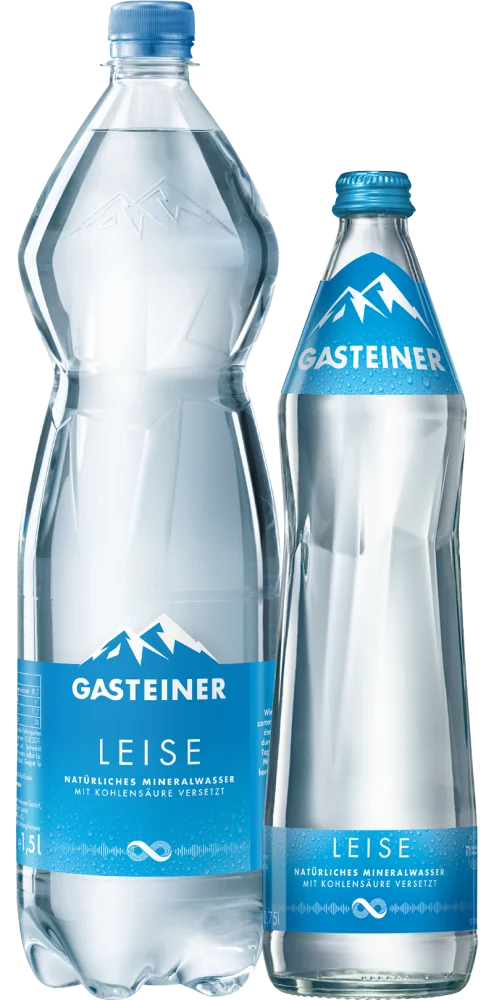
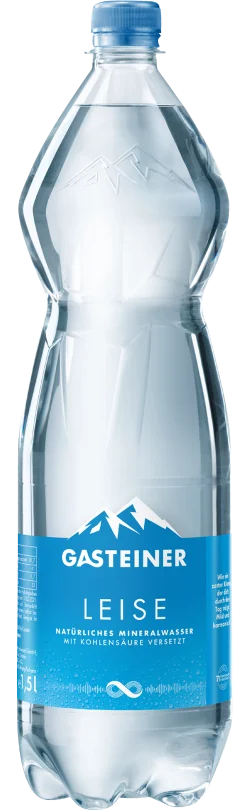
Mild Gastein mineral water. Carbonated.

Questions about our products?
Here you will find quick answers to the most frequently asked questions about our products and our company. For further information, please do not hesitate to contact us: office [at] alpinebrands.at (office[at]alpinebrands[dot]at)
Unlike tap water, mineral water in Austria must meet specific criteria defined by the Mineral Water and Spring Water Ordinance. These include, for example, that the water must be of natural purity, meaning it must not be treated. It must also contain a certain level of minerals, have a consistent composition and, of course, be free from harmful microorganisms. In short: nothing is altered in its essential components. It remains exactly as it is – fresh from the Hohe Tauern, straight into the bottle.
Our Gasteiner mineral water is, of course, microbiologically tested at the source to ensure impeccable quality. This ensures that it contains no harmful pathogens. Its natural microflora, however, is preserved. Such microflora is found in all water from natural sources and is completely harmless.
Thanks to its mild mineral content, Gasteiner mineral water helps hydrate the body’s cells particularly effectively. This allows waste products to be flushed out more easily and helps supply the body with oxygen and nutrients quickly. The result is greater vitality – improved concentration and enhanced performance.
Gasteiner Mineral Water is a pure natural product because it comes from the unspoilt nature of the Hohe Tauern. On its way to the spring, it seeps through the various layers of rock in the Alpine mountains, enriching itself with natural minerals and valuable trace elements. This is how it reaches our spring in Bad Gastein after a long journey. And because we leave it as it is, Gastein mineral water is 100% pure nature.
Just like tap water, mineral water supplies the body’s cells with vital fluids. However, unlike tap water, mineral water cannot be contaminated by the in-house pipe system. In the case of Gasteiner, this original purity of the water is particularly exceptional, as it is the only mineral water to come from the ancient rock formations of the protected Hohe Tauern National Park.
When our bottles are returned, they enter a recycling process. Our PET bottles are then turned into new PET bottles. At this point, we would like to highlight the company PET2PET, where the majority of Austria’s PET bottles are recycled.
TFA is the abbreviation for trifluoroacetate, also known as trifluoroacetic acid. TFA is formed as a degradation product of many fluorinated compounds and has been categorised by the OECD as a per- and polyfluoroalkyl substance (PFAS) since 2021. These substances can be found in plant protection products (pesticides), for example, as well as in refrigerants.
TFA is very stable and difficult to break down, which means it can accumulate in the environment and persist for long periods of time. As it is also highly soluble in water, it can enter the entire water cycle, for example through precipitation.
In Austria, there is currently no fixed, specific limit or guideline value for TFA in drinking water. The Austrian Drinking Water Ordinance – which is based on the EU Drinking Water Directive – only specifies a parameter value for total PFAS, which must be complied with from 12 January 2026. Whether TFA will be included in this parameter has not yet been determined and is currently being discussed at European level.
With regard to health risks, AGES (Austrian Agency for Health and Food Safety) points out that, according to current knowledge, the acute toxicity of TFA is very low. It also notes that the human toxicological relevance of TFA is currently being reassessed as part of several plant protection product renewal procedures.
One of the most common measurement methods is high-performance liquid chromatography (HPLC) coupled with mass spectrometry (MS). There is currently no uniformly recognised, harmonised measurement method for TFA. One does not yet exist.
As a result, studies on this topic are not representative, and the comparability of test results as well as the definition of limit values based on such results remain problematic.
Gastein insights: Inspiring stories and interesting facts
Learn more about our latest activities, projects and the world of Gasteiner mineral water
Dive into exciting stories that reflect our commitment to quality, sustainability and innovation.